
Cement Screw Conveyors and Feeders-ES
On order
Cement Screw Conveyors and Feeders-ES
Cement Screw Conveyors and Feeders - ES. Hundreds of thousands operating worldwide
Documents
CHARACTERISTICS
Cement Screw Conveyors and Feeders - ES. Hundreds of thousands operating worldwide
Description:
- As a specialised version of the modular TU Screw Conveyor System, ES Screw Conveyors and Feeders are manufactured from carbon steel with suitable surface finishing and powder coating.
- They are made up from a tubular trough equipped with at least one inlet and outlet spout, a welded flange at each tube end, helicoid screw flighting welded on a centre pipe with coupling bush at each end, two end bearing assemblies complete with self-adjusting shaft seal (one of the bearing assemblies is integrated into the drive unit), and a number of intermediate hanger bearings depending on the overall length.
- ES Screw Conveyors and Feeders are equipped with a gear motor that suits the application.
Function
- ES Screw Conveyors and Feeders are used for conveying or feeding cement and materials similar to cement mainly in concrete batching plants but also in other building materials processing plants.
Features
- Powder-coated.
- 7 outside tube diameters.
- Outside tube complete with welded end flanges, one inlet, one outlet, inspection hatch beneath the first inlet and beneath each intermediate hanger bearing.
- Tubular housing in standardised flanged sections with one section made to measure.
- Helicoid screw flighting welded on centre pipe.
- End bearing assemblies complete with self-adjusting shaft seal.
- Splined shaft couplings.
- Lifting eyelets on each tube section.
- Standard flange-mounted electric motor.
- Maintenance-free aluminium-cast intermediate hanger bearings with self-lubricating slide bushes.
- Compact design and overall dimensions.
- Reduced number of components and spare parts.
Benefits
- Durable.
- Maintenance-free.
- Quick installation due to universal inlet and outlet spouts.
- Optimum price-performance ratio.
Options
- Different types of inlet and outlet spouts.
- Additional inspection hatches.
- External supports.
- Drive unit at outlet end.
- Selection of gear ratios resulting in different feed rates.
Related products
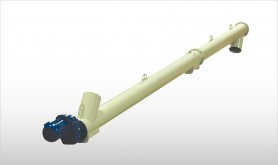 Tubular Screw Conveyors
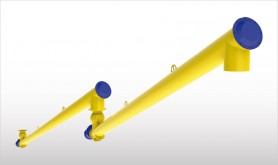 Filler Dust Screw Feeders-Conveyors THF-TCF
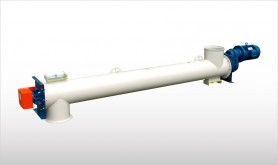 Heavy-Duty Tubular Screw Conveyors TP-TE
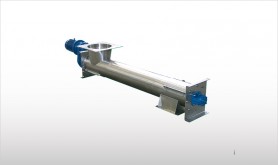 Stainless Steel Tubular Screw Conveyors-TX
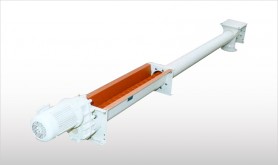 Single Shaft Screw Feeders-SU
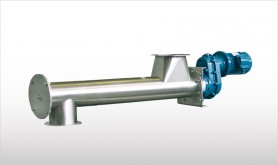 EASYCLEAN-Minimum Residue Tubular Screw Feeders
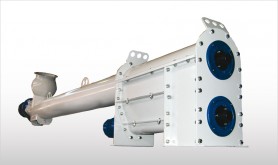 Micro-Feed Screws SPL
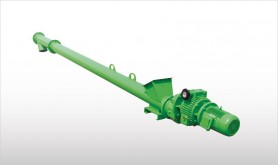 Tubular Ribbon Flight Screw Feeders - PR
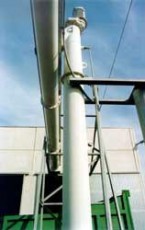 Vertical Screw Conveyors for Sludge-SVE
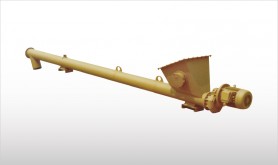 Volumetric Cement Screw Feeders-ESV
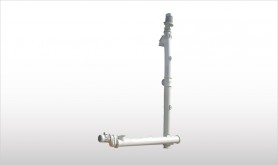 Vertical Screw Conveyors VE